Agata
The PeasantsAgata, the elderly beggar of Lipce, gives The Peasants one of its clearest portraits of how poverty persists inside the routines of kinship and custom. After transferring her property to her children, she is left to beg for her winter living and to pay for care in old age. The novel follows her between the village and the road: a figure made socially marginal by the very family arrangements meant to protect her, yet capable of generosity toward people whose needs resemble her own. Her eventual death, attended by the community and prepared for with painstaking care, grants her a dignity that her daily life seldom affords.
Identity and the seasonal circuit
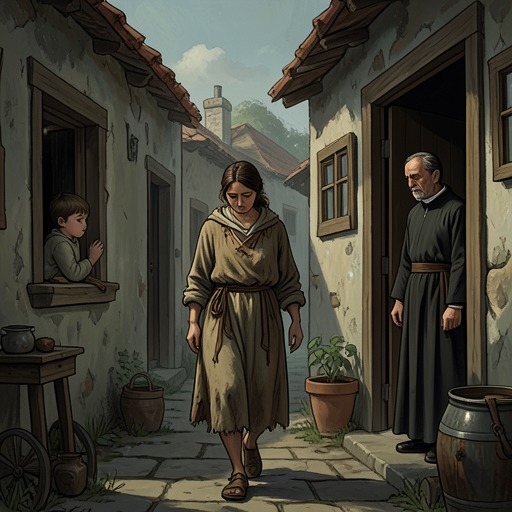
Agata appears at the opening of the novel as she prepares to leave Lipce to beg. The Parish Priest of Lipce greets her while supervising ploughing and discreetly gives her a zloty. The small gift helps her for a moment but does not alter the circumstances that send her onto the road. With her bags and a staff topped with hedgehog spines, she takes the rutted way toward the forest, repeatedly looking back at the village, the potato fields, and the smoke drifting above the stubble. The landscape she leaves behind is also the place to which she expects to return.
Her departure is seasonal rather than a clean severing from kin. She explains that the Kłąbs have not formally turned her out: she had worked for them through the summer, but winter is coming, and there is no more work for her. With a young bullock and goslings needing shelter from the cold, she believes she must make room by leaving. She expects to come back in spring, bringing what she has saved from begging, and imagines that her relatives will then welcome her again. Her account presents the arrangement as reasonable and voluntary; the circumstances reveal how little freedom that choice contains.
That cycle is the human consequence of the aliment arrangement described in the novel. After Agata signed over her property to her children, she was driven out to beg and earn money that would help pay her relatives for her care. Her kinship gives her a place to return to, but not a secure claim on shelter when she can no longer contribute work. The system turns old age into a precarious exchange: labor and savings may purchase temporary welcome, while winter need makes the elderly woman expendable.
Poverty, kinship, and practical generosity
Agata’s movements around Lipce bring her into contact with poverty beyond her own. When she comes upon Tomasz Kłąb suffering through the difficult period before harvest, she offers him money she had put aside for her burial. She first presses roughly three roubles in zlotys on him, then urges him to accept an additional half-rouble. The money could preserve a heifer, valuable stock whose future usefulness she remembers from its birth the previous year. Her offer is not an abstract gesture: she gives up part of the fund intended to secure her own funeral in order to help a farmer protect a source of livelihood.
Tomasz does not accept the loan, and Agata’s hope that she might stay with him is not fulfilled. She admits that she can no longer keep up with the goslings or offer useful labor, and worries about eating without earning her place. Though she says it would be better to die among kin, even in an old animal stall, she does not insist on being taken in. She leaves again, moving through the village to look for an honest place where she might die properly. The rejected offer of shelter makes the limit of her kinship especially plain: she can risk her burial savings for another household, but cannot assume that household will take responsibility for her.
Her knowledge of hardship also makes her attentive to those around her. During a period when men are imprisoned and fields stand fallow, she describes the hunger and exposure of neighboring households: a sick girl in a freezing cottage whose windows are stuffed with straw, a family that has sold its quilt and has no potatoes, and a new mother without milk or money. Agata has reason to feel wronged by her own children, but she goes to help a woman in labor rather than letting resentment keep her away. The account links her compassion to the practical work of survival: carrying help into a cold house, tending the vulnerable, and recognizing that need has spread through the village.
At another point, Agata pays Kozłowa the firebrand twenty zlotys to keep her until death, with burial costs left separate. She expects to die soon, but instead recovers and moves out. The arrangement shows that even care purchased with money can be uncertain: Agata’s payment secures a place on terms, not lasting belonging. When the villagers later discuss her, they note that she has taken her bedding and probably has some cash, is embittered with her kin, and does not want to remain with them. She keeps her chest with the village head and looks for a peaceful place to die. Others imagine that she will still be useful in cottages, minding geese or watching cows. The prospect of usefulness continues to shape how the village understands her place.
Faith, custom, and the village community
Religious practice accompanies Agata through both her departures and her returns. The Parish Priest of Lipce gives her money and sends her on her way with a blessing; she answers hardship with trust that Jesus will not abandon a person in need. That faith does not erase the material conditions around her. Rather, it supplies a language of endurance within a social order that offers no reliable remedy for her poverty.
Agata also appears at the end of a spring procession through the village, trailing behind the banners, clergy, and other participants. At a mound said to contain war dead, she remains behind when the others move on. She secretly tears cloth from the old cross and buries pieces along the field boundaries, following a superstition. The gesture sets her apart from the procession’s organized prayers, while placing her within the same landscape of crosses, fields, and inherited beliefs. Her religious life is not limited to formal observance; it includes private customs by which she tries to meet uncertainty on her own terms.
Her place in communal ritual becomes especially visible when Maciej Boryna dies. Agata comes to pray beside the body with Jagustynka and Ambrozy, and later recites the litany for the dead while the household is quiet. As night advances, she and Ambrozy remain to keep vigil. They continue their prayers until fatigue overtakes them, staying beside the dead man through the hours when the rest of the village has withdrawn. The old beggar who must search for shelter in life is nonetheless present in the village’s work of caring for the dead.
Preparing for death
When Jasio finds Agata collapsed in the hallway of the Kłąb household during harvest, he carries her inside, lays her on a bed, and gives her something to drink. She revives and tells him that she believes her end is near, but refuses to let him fetch the priest immediately. She understands herself to have more time and takes comfort in that interval. Her expectation of death is bound up with the possibility of meeting it in a prepared and religiously proper way, rather than alone on the road.
The contents of her chest make that preparation tangible. Agata lays out fresh bedding and a clean sheet, holy water, a sound aspergillum, a votive candle, an image of Our Lady of Częstochowa, a new smock, a wool skirt, a carefully frilled cap, a headkerchief, and new shoes. She has gathered these things over a lifetime of begging and takes pleasure in showing them to the women, even trying on the bonnet and examining herself in a mirror. She asks to be dressed in them the next morning. The collection is a funeral dowry, but it is also a rare possession over which she exercises complete choice: she can arrange how she will appear and how she will be cared for at the end.
Agata remains conscious as people visit her. She holds a rosary, says farewell, and gives a few groszy to children who gather in the hallway and beneath the window, asking them to pray for her. As ripe rye is being cut in the surrounding fields, she lies beneath holy pictures and looks outward toward the landscape. When the day nears its end, she abruptly announces that her time has come, then falls back. Those around her kneel, Jasio reads the prayers for the dying, and Kłębowa lights the blessed candle. Agata repeats the prayers until her voice fails and she dies.
Dignity, framing, and significance
The village comes to pray over Agata’s body, and her death is regarded with envy for its apparent happiness and ease. The contrast is striking: the woman treated in life as a beggar dies with the care and ceremonial attention accorded to a person of standing. Her lifetime’s savings and carefully assembled belongings have secured not wealth but a final scene of order, religious observance, and communal presence. In this sense, her funeral preparations answer the insecurity that defined her seasonal departures without pretending that the insecurity has been remedied.
Agata also frames the novel’s larger account of an order that is repeatedly invoked but rarely changed. The opening greeting from The Parish Priest of Lipce accompanies her departure; at the other end, an old beggar’s farewell closes the narrative. Between those moments, religious blessing and occasional charity coexist with the economic arrangements that leave the elderly dependent on relatives, cash, and seasonal usefulness. Agata’s life makes that contradiction visible without turning her into a simple emblem of helplessness: she lends, helps, prays, keeps her own funeral goods, and seeks a place to die on terms she can recognize as proper. Her final dignity is real, but it arrives after a life in which shelter and belonging have remained conditional.